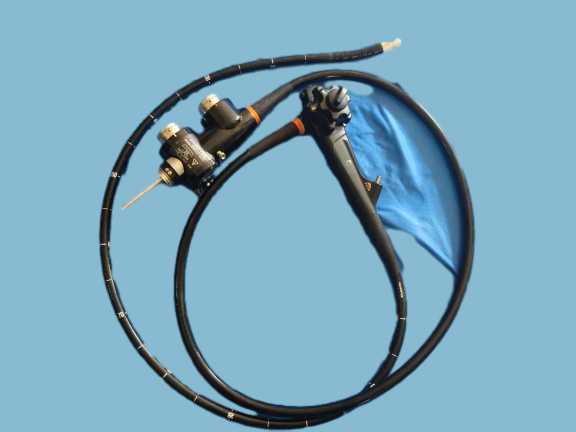
Olympus GF-UCT260 is a specialised medical endoscope used in diagnostic and interventional endoscopic ultrasound (EUS) procedures. It is not a regular camera or consumer product — it’s a high-end medical imaging instrument.
Type: Endoscopic Ultrasound (EUS) Ultrasound Gastroscope
Purpose: Combines endoscopy (visual inspection of the upper gastrointestinal tract) with ultrasound imaging from the tip of the scope to examine structures inside and beyond the walls of the digestive tract — especially the pancreas, bile ducts, and nearby organs.
Key Features & Specs
Ultrasound + Video Endoscope: Provides both endoscopic video and ultrasound imaging in one instrument. This helps doctors diagnose and guide biopsies or treatments with real-time imaging.
Curved Linear Array Transducer: The ultrasound transducer at the tip emits sound waves and receives echoes to form detailed images of internal structures.
Field of View: Typically a wide forward/oblique view for endoscopy coupled with an ~180° ultrasound scan range.
Size & Communication: Insertion tube outer diameter ≈ 12.6 mm, working length ~1250 mm, instrument channel ~3.7 mm — allowing standard biopsy and therapeutic tools to pass through.
Used With Ultrasound Processors: Needs a compatible ultrasound processor (e.g., Olympus EU-ME series) to power the ultrasound imaging.
Optical / Endoscopic Specifications
Field of View (endoscopic): ~100°
Direction of View: Forward oblique ~55°
Depth of Field: 3 – 100 mm
Minimum Visible Distance: ~6 mm
Physical Dimensions
Distal End Outer Diameter: ~14.6 mm
Insertion Tube Outer Diameter: ~12.6 mm
Working Length: ~1,250 mm
Total Length: ~1,555 mm (overall scope length)
Instrument Channel
Channel Inner Diameter: ~3.7 mm — accommodates standard EUS biopsy tools and therapeutic devices.
Bending / Maneuverability
Angulation Range:
• Up: ~130°
• Down: ~90°
• Right / Left: ~90° each
Clinical Use
The GF-UCT260 is designed for diagnostic and interventional EUS procedures, especially for imaging and sampling structures in and around the digestive tract (e.g., pancreas, bile ducts). It’s typically paired with advanced ultrasound processors like the Olympus EU-ME2 / EU-ME3 or similar systems.


 Your message must be between 20-3,000 characters!